


Neck pain can disrupt every aspect of your life in Findlay, Ohio, from focusing at work to enjoying a good night's sleep. If you're searching for a "neck pain chiropractor" or "chiropractor near me," you've likely experienced the persistent ache, stiffness, and tension that holds you back. The good news is that lasting relief is within reach, and it often begins with a combination of professional chiropractic care and gentle, targeted movements designed to restore function.
At Integrity Chiropractic and Wellness, our third-generation chiropractor, Dr. Hamilton Wetzel, serves the Findlay community by combining precise chiropractic adjustments with customized therapeutic exercises to address the root cause of your discomfort. This guide provides eight powerful yet safe exercises for neck pain relief, designed to complement our professional chiropractic care and empower you on your journey to wellness.
Whether your pain stems from long hours at a desk, a recent auto injury like whiplash, or chronic postural issues, these movements can help. They are designed to reduce tension, strengthen supporting muscles, and restore healthy function to your cervical spine. By incorporating these exercises into your routine, you can take an active role in managing your symptoms and preventing future flare-ups. To complement your exercise routine, ensure your sleep posture is optimally supported by exploring guides on the best pillows for neck pain.
This comprehensive guide will provide clear, step-by-step instructions for each exercise. You'll learn how to perform movements like Neck Isometric Exercises, Chin Tucks, and Thoracic Spine Mobility exercises correctly to maximize their benefit and find relief here in Findlay.
1. Neck Isometric Exercises
When you're dealing with neck pain, especially an acute flare-up, the idea of moving your neck can seem painful. Neck isometric exercises offer a powerful solution for this exact scenario. This technique is a cornerstone of effective exercises for neck pain relief because it allows you to engage and strengthen crucial neck muscles without any actual movement of the cervical spine.
The principle is simple: you apply gentle pressure with your hand to your head, and your neck muscles contract to resist that pressure, holding your head perfectly still. This static contraction builds strength in the deep cervical stabilizer muscles, which act like a natural brace for your neck, improving stability and reducing strain on your joints and discs.
Why Isometrics Are a Go-To for Neck Pain
For individuals in Findlay experiencing sudden neck stiffness or recovering from an auto injury like whiplash, isometrics are often the first line of defense we recommend. Because they don't involve joint motion, they are exceptionally safe and help build a foundation of strength without irritating inflamed tissues, making them a safe first step toward recovery.
Key Insight: Isometric exercises are ideal for the initial stages of neck pain recovery. They activate and strengthen muscles without the risk of aggravating sensitive joints, making them a safe starting point before progressing to dynamic movements.
How to Perform Neck Isometric Exercises
You can perform these exercises discreetly at your desk, at home, or during a break. The goal is steady, gentle resistance, not a test of strength.
- Forward Flexion: Place your palm on your forehead. Gently press forward with your head while resisting the movement with your hand. Hold for 5-10 seconds and relax.
- Backward Extension: Clasp your hands behind your head. Gently press your head backward into your hands, using them to provide resistance. Hold for 5-10 seconds.
- Side Bending (Left & Right): Place your right palm on the right side of your head. Gently press your head into your hand while your hand resists the motion. Hold, then repeat on the left side.
For a balanced routine, aim for 2-3 sets of 5 repetitions in each direction. Remember to keep your shoulders relaxed and breathe steadily throughout the exercise.
2. Gentle Neck Stretches (Cervical Flexion, Extension, and Lateral Flexion)
After establishing foundational stability with isometric exercises, the next step in achieving lasting neck pain relief is to restore flexibility. Gentle neck stretches are designed to carefully elongate tight, overworked muscles, reducing the stiffness that often contributes to pain and limited mobility. These controlled movements take your neck through its primary ranges of motion, easing tension and promoting better circulation.
The goal is to gently lengthen the muscles surrounding your cervical spine. This includes forward bends (flexion), backward tilts (extension), and side-to-side movements (lateral flexion). Unlike dynamic stretching, these are slow, sustained holds that allow muscle fibers to relax and release, helping to reset posture and alleviate strain from activities like prolonged computer use.
Why Gentle Stretches Are Essential for Mobility
For many patients in Findlay dealing with chronic neck ache or stiffness, tight muscles are a primary culprit. Gentle stretches are a cornerstone of our chiropractic care because they directly address this muscular tension. They are exceptionally effective for warming up the neck in the morning or resetting posture during work breaks after a long day in the office.
Key Insight: Gentle stretching is crucial for improving flexibility and reducing muscle tension, a common source of neck pain. By moving slowly and holding each stretch, you can safely increase your range of motion and prevent the buildup of stiffness.
How to Perform Gentle Neck Stretches
The key to these stretches is to move slowly and avoid any sharp or shooting pain. Never force a movement; the aim is a mild, comfortable pull.
- Cervical Flexion (Chin to Chest): Sit or stand tall with your shoulders relaxed. Slowly lower your chin toward your chest until you feel a gentle stretch along the back of your neck. Hold for 15-30 seconds.
- Cervical Extension: From a neutral position, gently tilt your head backward, looking up toward the ceiling. Hold for 15-30 seconds, being careful not to compress the back of your neck too much.
- Lateral Flexion (Ear to Shoulder): Keeping your shoulders down, slowly tilt your right ear toward your right shoulder until you feel a stretch on the left side of your neck. Hold for 15-30 seconds, then gently return to the center and repeat on the left side.
For best results, perform this series of stretches 2-3 times per day. Remember to breathe deeply to enhance relaxation and stop immediately if you feel any sharp pain.
3. Chin Tucks (Cervical Retraction)
Of all the exercises for neck pain relief, the chin tuck is perhaps the most powerful for correcting the root cause of much modern discomfort: forward head posture. This condition, often called "text neck," results from hours spent hunched over computers and phones. A chin tuck is a subtle but profound movement that directly counteracts this damaging habit by strengthening the deep cervical flexor muscles at the front of your neck and stretching the tight suboccipital muscles at the base of your skull.
This exercise works by retraining your body to hold your head in proper alignment over your shoulders. By gently drawing your chin straight back, as if you're making a "double chin," you realign the vertebrae in your cervical spine. This simple action can take immense pressure off the delicate nerves and discs, providing significant relief, especially for those with chronic stiffness and headaches.

Why Chin Tucks Are a Go-To for Postural Pain
For desk workers in Findlay and anyone struggling with the effects of poor posture, chin tucks are a foundational exercise we recommend. It's an essential movement for rebuilding proper cervical alignment after an auto injury or simply reversing daily strain. Because it addresses the underlying postural issues that lead to needing a "back pain chiropractor," its benefits are often long-lasting. A chiropractor can help with fixing posture through a comprehensive plan.
Key Insight: The chin tuck is not just a stretch; it's a postural re-education exercise. Consistent practice trains your neck muscles to maintain a healthy head position, actively preventing pain before it starts.
How to Perform Chin Tucks
You can do this exercise anywhere, but it’s most effective when you are sitting or standing tall with your shoulders back.
- Starting Position: Sit or stand straight, looking directly ahead. Relax your jaw and shoulders.
- The Movement: Without tilting your head, gently guide your chin and head straight back. Imagine a string pulling the back of your head backward. You should feel a stretch at the base of your skull.
- Hold and Release: Hold the "double chin" position for 3-5 seconds, then slowly release back to the neutral starting position.
Aim to perform 10-15 repetitions, 3-4 times throughout the day. Setting reminders is an excellent way to break the cycle of forward head posture.
4. Shoulder Shrugs and Scapular Retractions
It might seem counterintuitive, but the key to relieving neck pain often lies in strengthening the muscles around it, particularly in your upper back and shoulders. Shoulder Shrugs and Scapular Retractions are foundational exercises designed to do just that. They target the trapezius and rhomboid muscles, which form a critical support system for your neck and head.
When these upper back muscles are weak, often from prolonged sitting or poor posture, the smaller muscles in your neck are forced to overcompensate, leading to strain, stiffness, and chronic pain. By strengthening this muscular support system, you improve your posture, reduce the burden on your cervical spine, and build a more resilient foundation.
Why This Duo Is Essential for Neck Stability
For desk workers in Findlay battling "tech neck," these exercises are a game-changer. As local chiropractors, we frequently prescribe shrugs and retractions to create stability around the cervical spine. Activating these large muscles helps realign the shoulder girdle, which in turn encourages proper head and neck posture, providing lasting relief from neck and back pain.
Key Insight: A strong upper back is a stable base for your neck. Shoulder shrugs and scapular retractions directly combat the muscular imbalances caused by modern lifestyles, offloading stress from the delicate structures of the cervical spine.
How to Perform Shoulder Shrugs and Scapular Retractions
These movements are simple enough to perform anywhere, focusing on slow, controlled execution.
- Shoulder Shrugs: Stand or sit tall with your arms at your sides. Slowly lift your shoulders straight up toward your ears. Hold briefly, then slowly lower them back down. Avoid rolling your shoulders.
- Scapular Retractions: Sit or stand with your arms at your sides. Without shrugging, gently squeeze your shoulder blades together as if you are trying to hold a pencil between them. Hold this contraction for 2-3 seconds, then slowly release.
Aim for 2-3 sets of 10-15 repetitions for each exercise. Performing this routine 3-4 times per week is an excellent way to build the upper back strength needed for sustainable neck pain relief.
5. Levator Scapulae Stretches
If you've ever felt that persistent, nagging ache at the top of your shoulder blade that radiates up into your neck, you've likely met your levator scapulae muscle. This muscle, which connects your upper cervical spine to your shoulder blade, is notoriously prone to tightness from poor posture, stress, and repetitive tasks. A targeted levator scapulae stretch is one of the most effective exercises for neck pain relief because it directly addresses this common source of tension.
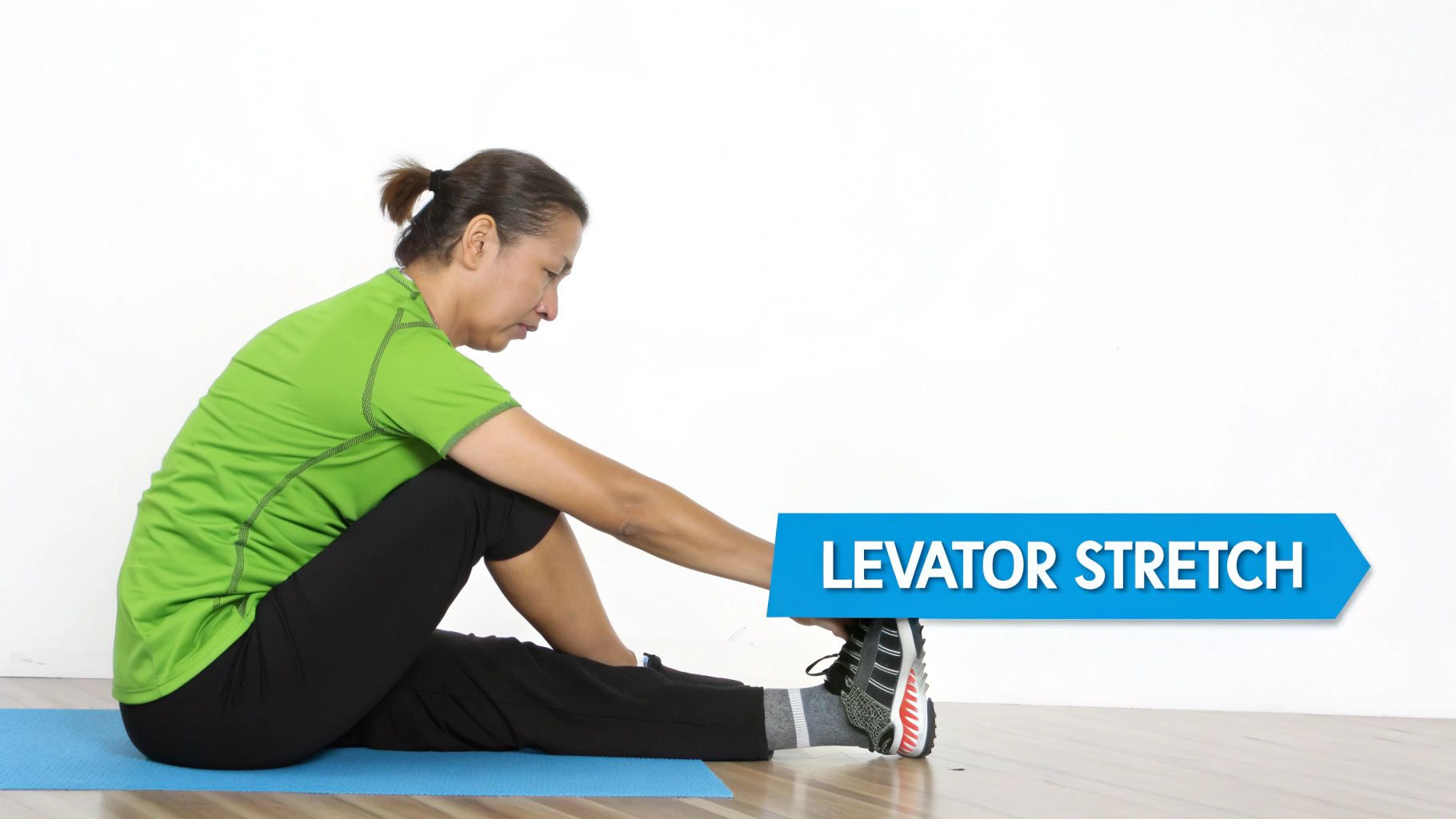
This gentle movement helps release built-up tension, improving flexibility and reducing the pulling sensation that often contributes to neck stiffness and even tension headaches. By isolating and stretching this specific muscle, you can alleviate a primary trigger for discomfort.
Why This Stretch Is a Game-Changer
For many Findlay residents, especially office workers, the levator scapulae becomes chronically tight. This stretch is a go-to recommendation from our clinic because it provides immediate, noticeable relief. It's a simple yet powerful tool for combating daily stress and postural strain. Releasing this muscle can also alleviate tension headaches linked to neck tightness; you can learn more about relieving tension headaches naturally.
Key Insight: The levator scapulae stretch is highly effective because it targets a specific, commonly overworked muscle. It's an excellent exercise for those who feel pain localized at the base of the neck and top of the shoulder.
How to Perform the Levator Scapulae Stretch
To get the most out of this stretch, focus on a gentle, sustained hold rather than forceful pulling.
- Starting Position: Sit upright in a chair with your feet flat on the floor. To stretch your right side, place your right hand behind your back or hold onto the side of the chair to keep your shoulder down.
- The Stretch: Turn your head about 45 degrees to the left. Gently tuck your chin down toward your left armpit until you feel a comfortable stretch along the back-right side of your neck.
- Applying Gentle Pressure: For a deeper stretch, place your left hand on the back of your head and apply very light, gentle pressure. Do not pull your head down.
- Hold and Repeat: Hold the stretch for 20-30 seconds while breathing deeply. Slowly release and repeat on the other side.
Aim for 2-3 repetitions on each side, performing the routine 2-3 times throughout the day. This is a fantastic way to prevent the buildup of tension that leads to chronic neck pain.
6. Resistance Band Neck Exercises
Once you've built foundational strength with isometric exercises, the next step toward lasting neck pain relief is to introduce controlled movement with resistance. Resistance band neck exercises are an exceptional way to do this. They provide a safe and effective method for progressively strengthening the deep cervical stabilizer muscles through their full range of motion.
The principle behind resistance bands is variable resistance. The tension increases as you stretch the band, challenging your muscles more at the end of the movement. This dynamic is ideal for the delicate structures of the neck, as it builds functional strength without the jarring impact of heavy weights.
Why Resistance Bands Are a Key Step-Up
For patients in Findlay looking to move beyond initial pain management, resistance bands are a staple in our progressive chiropractic rehabilitation programs. They are perfect for home-based neck rehab following an injury or for building preventive strength after acute symptoms have stabilized. By systematically increasing the challenge, you encourage muscle adaptation and resilience.
Key Insight: Resistance band exercises bridge the gap between static holds and functional strength. They are the ideal tool for safely progressing your neck rehabilitation, building the endurance and stability needed to prevent future flare-ups.
How to Perform Resistance Band Neck Exercises
Always start with the lightest resistance band and prioritize slow, controlled movements.
- Forward Flexion: Anchor the band behind you at head level. Place the band against the back of your head. Gently nod your chin toward your chest, moving against the band's resistance. Hold for 2-3 seconds, then slowly return.
- Backward Extension: Anchor the band in front of you. Place the band against your forehead. Gently press your head backward, retracting your chin, against the resistance. Hold briefly and return to the start.
- Side Bending (Left & Right): Hold the band with your right hand, anchoring it by your right hip. Loop the other end over the top of your head. Gently tilt your left ear toward your left shoulder, stretching the band. Slowly return and repeat on the other side.
Aim for 2-3 sets of 8-12 repetitions for each direction, performing the routine 3-4 times per week. As you advance, applying the principles of progressive overload by using a stronger band or increasing repetitions is key to continuously building strength.
7. Cervical Retraction with Extension (McKenzie Extension Exercises)
The McKenzie Method offers a structured approach to certain types of mechanical neck pain, like sciatica-like symptoms that radiate from the neck. Cervical retraction with extension is a key exercise in this system, combining a chin tuck with a gentle backward head tilt. This powerful sequence is designed to "centralize" pain—moving symptoms from your arm or shoulder back toward the source in your neck, which is a strong indicator of healing.
This exercise creates a subtle pumping action within the cervical spine. This motion can help reduce pressure on sensitive nerve roots and improve the position of the cushioning discs between your vertebrae. For individuals with certain disc-related issues or radiating symptoms, this can be one of the most effective exercises for neck pain relief when performed correctly.
Why McKenzie Extension Is a Powerful Tool
For patients in Findlay whose pain changes based on their posture or specific movements, the McKenzie Method provides a way to self-treat and manage symptoms. As your chiropractor, we often use this "directional preference" principle to identify the exact movements that alleviate pain. If backward bending provides relief, this exercise becomes a primary therapeutic tool.
Key Insight: This exercise is particularly beneficial for pain that radiates from the neck into the shoulder or arm, such as with a pinched nerve. By centralizing symptoms, it actively works to resolve the root mechanical cause of the irritation.
How to Perform Cervical Retraction with Extension
Precision and control are crucial for this exercise. The movement should be slow, deliberate, and performed within a pain-free range.
- Step 1: Retraction (Chin Tuck): Sit or stand tall. Gently glide your head straight back, as if making a double chin, without tilting your head.
- Step 2: Add Extension: Once fully retracted, gently tilt your head backward, looking up toward the ceiling. Move only as far as is comfortable.
- Step 3: Return to Neutral: Slowly return to the chin tuck position first, and then relax your head back to a neutral starting posture.
Hold the end position for 2-3 seconds and aim for 1-2 sets of 10 repetitions. Stop if your symptoms worsen or spread further down your arm. Because this exercise is specific, it's best to confirm with your chiropractor that it is appropriate for you. You can learn more about how to fix a pinched nerve and see if this approach aligns with your symptoms.
8. Thoracic Spine Mobility Exercises (Upper Back Mobility)
It may seem unusual to address neck pain by focusing on the mid-back, but the connection is incredibly strong. When your thoracic spine (the upper and middle part of your back) becomes stiff and immobile, your much more flexible cervical spine is forced to overcompensate. Improving thoracic mobility is a key part of any good plan for neck pain relief.

The principle is straightforward: improving mobility in your thoracic region distributes movement more evenly across your entire spine. This reduces the excessive strain placed on the delicate joints and muscles of your neck. For desk workers in Findlay, this is a game-changer, as prolonged sitting is a primary cause of thoracic stiffness.
Why Upper Back Mobility Is a Key to Neck Health
As a local chiropractor in Findlay, OH, we frequently emphasize the cervical-thoracic connection because a mobile upper back is essential for proper posture and healthy movement. By "unlocking" a stiff thoracic spine, you create a stable foundation that allows the neck to move freely and without pain. This proactive approach not only alleviates current discomfort but also helps prevent future flare-ups.
Key Insight: A stiff upper back is a hidden cause of chronic neck pain. Mobilizing the thoracic spine takes pressure off the cervical joints, making it a critical strategy for long-term relief and improved posture.
How to Perform Thoracic Spine Mobility Exercises
These movements are designed to be gentle and controlled. They are perfect for a warm-up or as a break from sitting.
- Cat-Cow Stretch: Start on your hands and knees. Inhale as you drop your belly and look up (Cow Pose), then exhale as you round your spine and tuck your chin (Cat Pose). Focus the movement between your shoulder blades.
- Thoracic Extension on Foam Roller: Lie on your back with a foam roller placed horizontally under your upper back. With your hands supporting your head, gently extend your upper back over the roller.
- Quadruped Thoracic Rotation: On your hands and knees, place one hand behind your head. Rotate your elbow and chest toward the ceiling, opening up your upper back. Repeat on the other side.
Aim to incorporate these movements into your routine 4-5 times per week. For dynamic stretches like Cat-Cow, perform 10-15 repetitions. For static holds, aim for 20-30 seconds.
Your Partner in Pain Relief: Schedule Your Consultation in Findlay, Ohio
Throughout this guide, we have explored a comprehensive collection of evidence-based exercises for neck pain relief. From foundational isometrics to more advanced mobility drills, you now have a powerful toolkit to begin managing your discomfort. Mastering these routines is a significant first step toward regaining control over your well-being.
The true value of these exercises is unlocked when integrated into a consistent daily or weekly schedule. By performing movements like chin tucks and scapular retractions, you are not just temporarily alleviating stiffness; you are actively re-educating the muscles that support your head and neck. This consistency is the key to creating lasting changes in posture, reducing pain, and building a more resilient cervical spine.
From Self-Care to Expert Care: Why a Professional Diagnosis Matters
While these exercises are a fantastic and proactive way to address neck pain, they are most effective when guided by a professional diagnosis. Self-treatment can manage symptoms, but lasting relief requires identifying and correcting the root cause of your pain. This is where our specialized chiropractic care at Integrity Chiropractic and Wellness becomes an indispensable part of your recovery.
An underlying issue, such as a spinal misalignment (subluxation), a disc injury in your neck, or chronic postural strain from your work environment in Findlay, may be the true source of your discomfort. Without addressing these core problems, even the most diligent exercise routine may provide only temporary benefits. A precise diagnosis from a trusted neck pain chiropractor ensures your efforts are correctly targeted for maximum and permanent results.
Your Path to Lasting Relief in Findlay, OH
At Integrity Chiropractic and Wellness, we see ourselves as your dedicated partners in health. Our approach combines the rehabilitative power of specific exercises with advanced, personalized chiropractic care. Dr. Hamilton Wetzel provides a comprehensive evaluation to pinpoint the exact cause of your neck pain, ensuring your treatment plan is tailored to your unique condition. We are committed to not just alleviating your symptoms but restoring optimal function to your entire body.
By integrating precise chiropractic adjustments with supportive therapies like non-surgical spinal decompression and cold laser therapy, we can address the structural issues that contribute to chronic pain. This comprehensive strategy accelerates your healing, enhances the effectiveness of the exercises for neck pain relief you perform at home, and provides you with the education needed to prevent future issues. Don't let neck pain continue to limit your daily life in Findlay.
Ready to address the root cause of your neck pain and create a personalized recovery plan? The team at Integrity Chiropractic and Wellness in Findlay, Ohio, is here to provide the expert diagnosis and patient-focused care you need. Schedule your comprehensive consultation today by visiting Integrity Chiropractic and Wellness and start your journey back to a life without pain.


